
Another Settlement, Same Broken System for Kia & Hyundai Owners
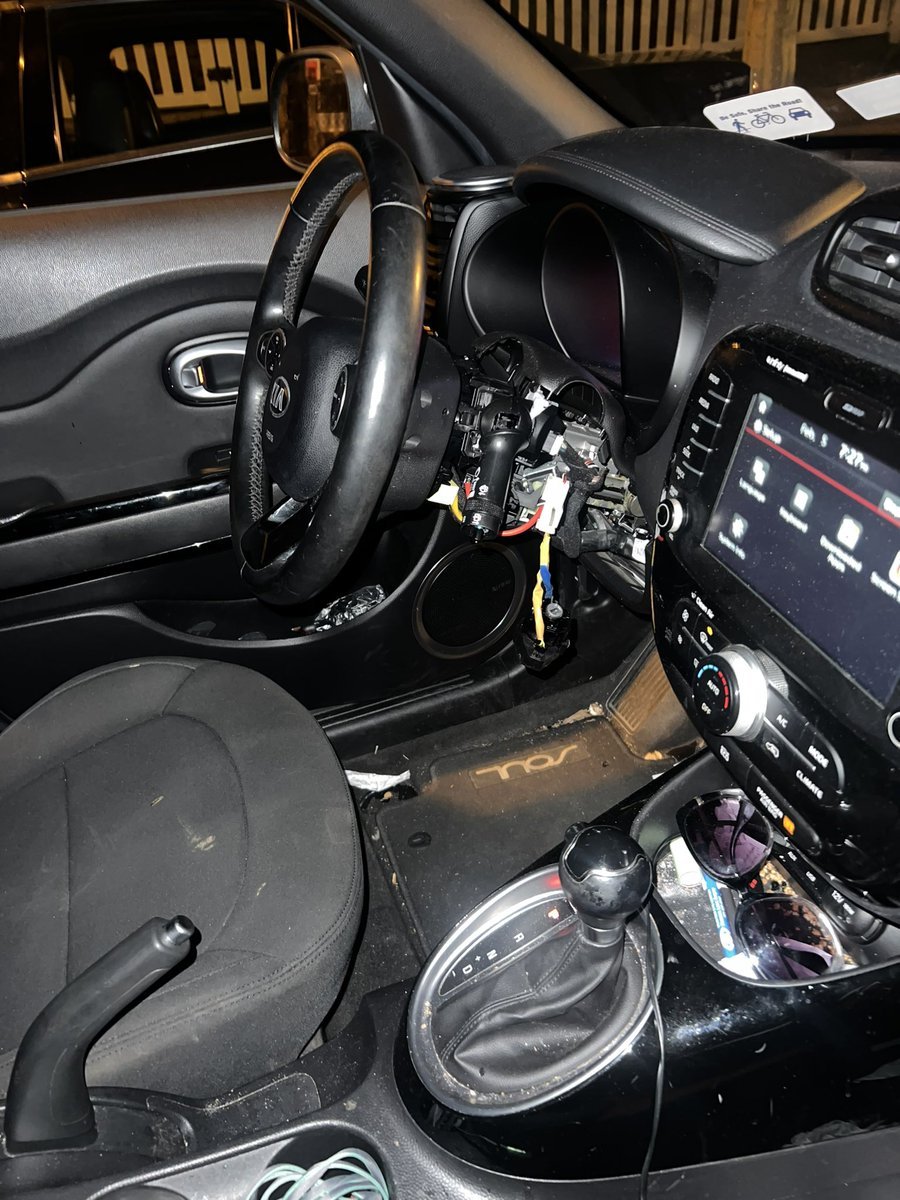
The aftermath of one of my car thefts.
Today, the DC Office of the Attorney General announced a multi-state settlement with Hyundai and Kia related to the well-documented ignition issue that made these vehicles easy targets for theft. On paper, it sounds like accountability. In reality, for many of us who actually lived through the fallout, it feels hollow.
My Kia was stolen twice in 18 months—both times from what were supposed to be secure DC parking garages. I did everything “right.” I paid for parking. I reported the thefts. I filed police reports. I dealt with insurance. I waited.
I’m still waiting for my claim from the original Kia settlement, now more than a year later.
Since the thefts, my life has turned into a constant exercise in vehicle defense. I’ve installed multiple cameras to monitor my car, added two separate trackers, purchased a new steering wheel security device, and installed an additional security system on top of everything else. I even use a car cover in my own garage and chain my car to a cement column every time I park. And this is after getting the reinforced ignition lock.
Even with all of that, I still don’t feel confident that my car is safe.
At this point, the aggravation, time, and energy spent just trying to keep my car in my possession feels like a second job—one I never signed up for and certainly am not being compensated for.
So when I read about this new multi-state settlement, my reaction wasn’t relief. It was frustration. This agreement doesn’t come close to addressing the real costs owners have absorbed: repeated thefts, repairs, skyrocketing insurance premiums, lost time, missed work, emotional stress, and the ongoing burden of extreme security measures that no car owner should have to take.
Settlements like this may look good in a press release, but they leave owners like me holding the bag. Until Hyundai and Kia are required to fully and efficiently make owners whole—not just announce fixes or partial reimbursements—this issue remains unresolved. Accountability shouldn’t end with a headline. It should end with real relief for the people who paid the price.
ATTORNEY GENERAL SCHWALB ANNOUNCES MULTISTATE SETTLEMENT WITH HYUNDAI AND KIA FOR SELLING CARS LACKING ANTI-THEFT TECHNOLOGY
Settlement Requires Hyundai and Kia to Offer Free Anti-Theft Hardware for All Affected Vehicles, Including 8,198 Vehicles Registered in DC
WASHINGTON, DC – Attorney General Brian Schwalb announced today that the District of Columbia, along with 34 states, has reached a settlement with automobile manufacturers Hyundai and Kia for their sale of millions of vehicles nationwide that lacked industry-standard anti-theft technology. This failure resulted in an epidemic of car thefts and joyriding across the country, creating serious threats to public safety. Nearly 8,200 Kia and Hyundai vehicles currently registered in DC are at elevated risk of theft. Under the settlement, Hyundai and Kia have agreed to:
Equip all future vehicles sold in the United States with industry-standard, engine immobilizer anti-theft technology;
Offer free hardware—zinc-reinforced ignition cylinder protectors—that makes cars much harder to steal to owners or lessees of eligible vehicles, including vehicles that were previously only eligible for the companies’ software updates;
Provide up to $4.5 million in restitution to eligible consumers whose cars were damaged by thieves; and
Pay $4.5 million to the multistate coalition to defray the costs of the investigation.
“This bipartisan, multistate settlement will help prevent car thefts and block criminals from easily stealing cars to use in other criminal activity,” said Attorney General Schwalb. “Even after Kia and Hyundai’s vulnerabilities were publicly exposed, resulting in a public safety crisis, the companies continued to cut corners and failed to make necessary fixes. Now, nearly 8,200 Kia and Hyundai owners in DC are eligible to have free anti-theft hardware installed in their cars. I strongly encourage everyone who is eligible to schedule installation of these devices as soon as possible.”
Many of Hyundai and Kia’s Vehicles Lacked Industry Standard Anti-Theft Technology.
Hyundai and Kia chose not to include anti-theft “engine-immobilizer” technology in millions of their vehicles sold throughout the United States. An engine immobilizer prevents thieves from starting a vehicle’s engine without the vehicle’s “smart” key, which stores the vehicle’s electronic security code. Hyundai and Kia dramatically lagged behind industry standards in this area. According to one report, in 2015, only 26% of the vehicles Kia and Hyundai sold in the United States were equipped with engine immobilizers, compared to 96% of the vehicles sold by other manufacturers.
Jurisdictions Across the Country, Including DC, Have Experienced a Drastic Increase in Hyundai and Kia Vehicle Thefts.
Car thieves devised a quick and simple way to access these vehicles’ ignition cylinders and start these cars without a key. This method quickly went viral on social media, leading to a drastic increase in Kia and Hyundai vehicle thefts throughout the nation. Not only did the number of thefts skyrocket, but many of the stolen vehicles were used in connection with other crimes and were involved in many traffic collisions, some fatal.
Hyundai and Kia’s Response to the Public Safety Crisis.
Hyundai and Kia were slow to respond to the crisis, waiting until 2023 to launch a service campaign to update the software on most of the affected vehicles. Hyundai and Kia also offered to install a zinc-reinforced ignition cylinder protector, but only for the roughly twenty percent of their vehicles that were ineligible for this software update. While the companies claimed that the software update was effective at preventing the viral theft method, the states alleged that the software update could be, and in fact was, easily bypassed by thieves.
The Settlement Secures Availability of Zinc-Reinforced Ignition Cylinder Protectors for All Affected Vehicles.
The Attorneys General pressed Hyundai and Kia to do more to protect consumers and their communities. As a result, Attorney General Schwalb has ensured that consumers with eligible vehicles registered in the District can have zinc-reinforced ignition cylinder protectors, which prevent thieves from accessing the ignition assembly, installed on their vehicles free of charge.
There are 2,560 registered Kias in DC and 5,638 registered Hyundais in DC that are eligible to have these anti-theft devices installed at no cost. The owners and lessees of these vehicles will be notified by the car companies that they have one year from the date of the notice to make an appointment to have the zinc-reinforced ignition cylinder protector installed at their local Hyundai or Kia authorized dealerships. Attorney General Schwalb urges consumers to schedule the installation of the zinc-reinforce ignition cylinder protector as soon as possible.
In addition, consumers who previously installed the software update on their vehicles (or were scheduled to do so) but experienced a theft or attempted theft of their vehicle on or after April 29, 2025, are eligible to file a claim for restitution for certain theft and attempted-theft related expenses. For more information about eligibility and how to submit a claim for compensation, please visit the following:
For Hyundai – Visit www.HKMultistateimmobilizersettlement.com
For Kia – Visit https://customercare.kiausa.com/SWLD or call (800) 333-4542
The attorneys general of Connecticut, Minnesota, and New Hampshire led the multistate settlement, and were joined by the District of Columbia, Arizona, California, Colorado, Delaware, Florida, Georgia, Hawaii, Illinois, Iowa, Kansas, Kentucky, Louisiana, Maine, Maryland, Massachusetts, Michigan, Mississippi, Nevada, New Jersey, New Mexico, New York, North Carolina, North Dakota, Ohio, Oklahoma, Oregon, Pennsylvania, Rhode Island, South Dakota, Vermont, Washington and Wisconsin.